
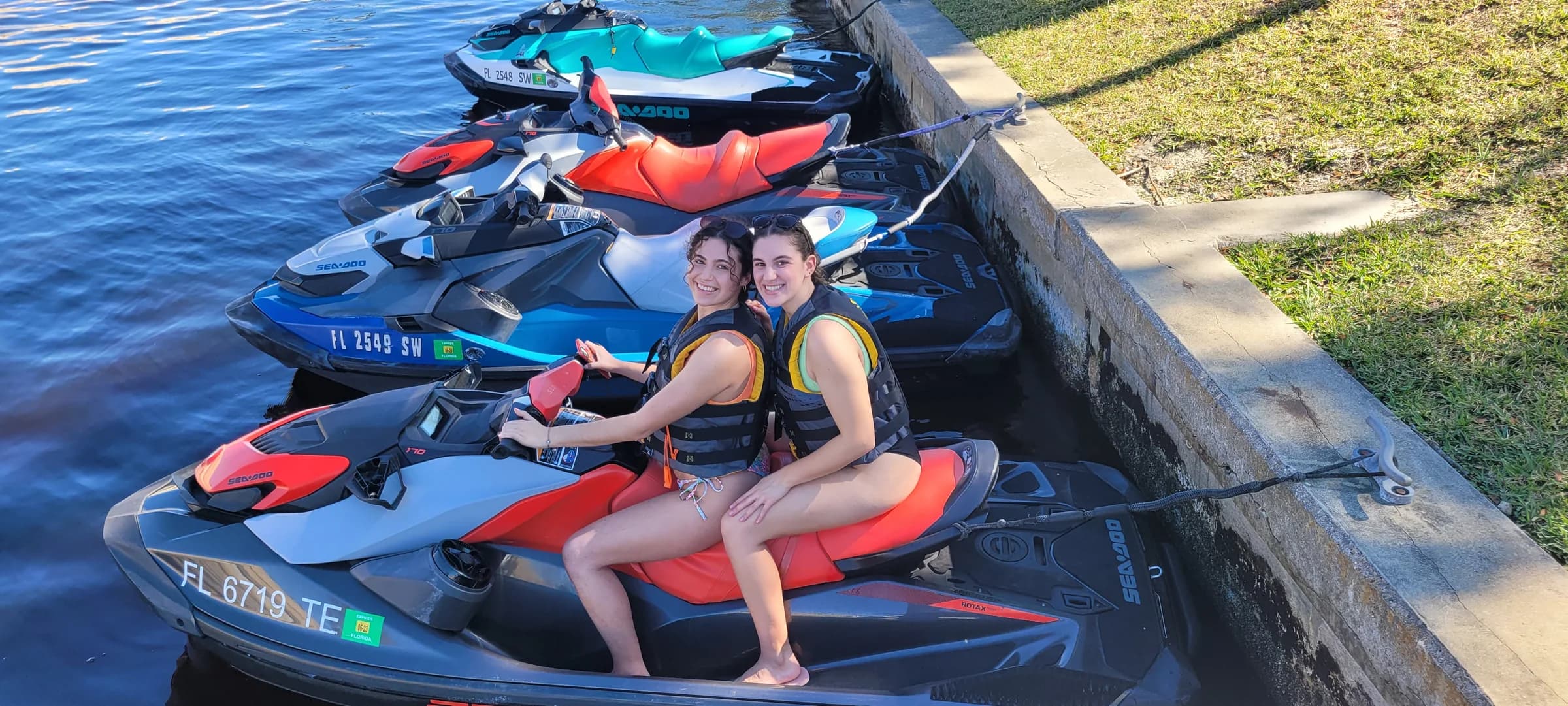
Before you ride
Florida Jet Ski License and Age Requirements
Florida treats a jet ski as a personal watercraft, or PWC. The rules are straightforward once you separate state law from the rental company’s operating policies. Use this guide to arrive ready, then confirm current requirements when you reserve.
01
The quick answer
Florida does not issue a traditional “jet ski license.” Instead, certain operators must show proof that they completed approved boating safety education. Rental operators may also set stricter age, identification, deposit, and experience requirements than the state minimum.
- A person must be at least 14 years old to operate a personal watercraft in Florida.
- A person must be at least 18 years old to rent a personal watercraft in Florida.
- Operators born on or after January 1, 1988 generally need a Florida Boating Safety Education Identification Card or accepted equivalent.
- Every rider must wear a properly fitted, approved personal flotation device.
- Photo identification and the payment method used for the reservation should be brought to check-in.
02
Who needs boating education?
Florida’s boater education rule is based on birth date, not simply age. If you were born on or after January 1, 1988 and will operate a motorboat of 10 horsepower or more, you generally must carry photo identification and proof of approved boating safety education while operating.
Visitors do not necessarily need a permanent Florida card. Florida recognizes certain out-of-state credentials, and eligible renters may be able to complete an approved temporary certificate process. Do not wait until departure time to discover what applies to your group; ask when booking and complete any required course beforehand.
03
Operator versus passenger
The operator is the person controlling the jet ski. A passenger does not need a boating card merely to ride behind an eligible operator, but must follow life-jacket and seating rules. If two adults plan to switch drivers, both should arrive prepared to qualify as operators.
- Tell the crew about every person who expects to drive.
- Never place a passenger in front of the operator where they can interfere with steering or throttle control.
- Stay within the watercraft’s listed capacity and follow the crew’s passenger guidance.
- Use the safety lanyard exactly as demonstrated during orientation.
04
What to bring to check-in
| Bring | Why it matters |
|---|---|
| Government-issued photo ID | Used to verify the renter and qualified operators. |
| Boater education proof | Required for covered operators unless a valid exemption or temporary certificate applies. |
| Reservation payment method | May be needed for verification, incidentals, or a security deposit. |
| Sun protection | Use reef-conscious sunscreen, sunglasses with a strap, and protective clothing. |
| Secure phone protection | A waterproof case with a tether helps protect your phone on the water. |
05
Rules that matter once you launch
Cape Coral’s canals, the Caloosahatchee River, bays, and Gulf approaches each demand different judgment. Follow posted slow-speed and manatee zones, maintain a proper lookout, leave generous distance from other vessels, and adjust for wakes, visibility, and traffic.
- Personal watercraft operation is restricted from one-half hour after sunset until one-half hour before sunrise.
- Reckless operation, wake jumping too close to another vessel, and weaving through traffic are prohibited.
- Idle-speed and slow-speed zones are enforceable even when open water is visible ahead.
- Weather, tide, experience, fuel range, and rental duration determine where you can safely ride.
Planning sources
Rules, forecasts, access, and rates can change. Review the controlling source before departure.
Make it real
Ready to trade the checklist for open water?
Choose a free-roam rental from one to eight hours, check availability, and let our Cape Coral crew walk you through the machine and local conditions.
Keep planning
Related local guides
Jet ski rental prices
Compare Cape Coral jet ski rental durations, current Nauti Hooker rates, likely extras, and how to choose the best-value riding time.
Read guide 02Cape Coral boating destinations
Explore realistic boating destinations from Cape Coral, including Pine Island, Sanibel, Captiva, Cabbage Key, and Cayo Costa, with route-planning advice.
Read guide 03Pontoon vs. center console
Compare pontoon and center-console rentals for capacity, comfort, fishing, range, handling, pricing, and different Cape Coral boating plans.
Read guide